The Seasons
Discover how the Engadin changes throughout the year.
The Engadin is never quite the same. The places remain, but the light changes. The wind, the colours, the sounds and even the rhythm of the valley transform from one season to the next.
These pages are not about what to do in summer or autumn. They are about noticing the small changes that make each season feel unique.
Sometimes all it takes is paying attention.
Three Ways to Notice Summer
Summer in the Engadin is about much more than sunny days and walks in the mountains. Year after year, three things remind me that the season has arrived: the wind that sweeps through the valley, the meadows bursting with wildflowers and the clear nights that invite you to look up at the sky.
When the Wind Crosses the Valley
When the valley comes to life.
If you spend a few summer days in the Engadin, you'll soon notice something. By late morning, the wind begins to blow. At first it is gentle, then it gradually becomes stronger, accompanying much of the afternoon. It is such a regular phenomenon that, for those who live here, it has become part of the rhythm of everyday life.
On the lakes, sails, kites and colourful kiteboards begin to appear. The trees start to sway, the water changes colour and the whole landscape seems to come alive.
Then, towards evening, the wind settles once again. If one day you feel as though the Engadin is breathing, it will probably be the wind telling you so.
Wildflower Meadows
Sometimes all you need to do is look down.
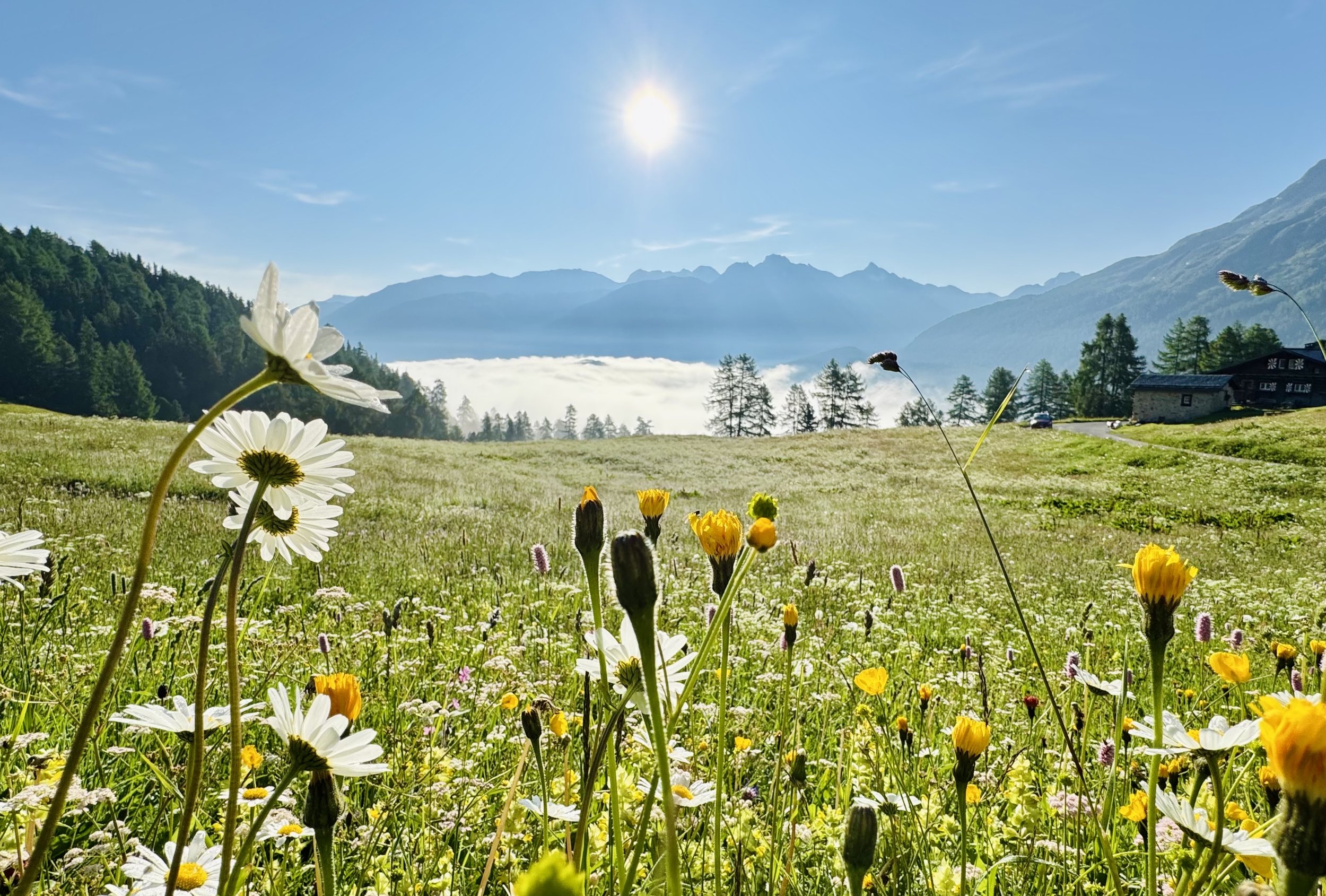
Between June and July, the Engadin bursts into bloom. Gentians, bellflowers, buttercups, arnica, clover and dozens of other wildflowers transform the meadows and alpine pastures into a constantly changing mosaic of colour.
It's easy to be drawn towards the mountains. But every now and then, try doing the opposite.
Look down. You may discover that the meadow at your feet can tell the story of the season just as beautifully as the peaks rising before you.
Summer Nights
When the sky becomes the main attraction again.
Far from large cities, the Engadin still enjoys remarkably dark night skies. On a clear evening, it's worth spending a few quiet minutes outdoors, perhaps after a walk or on your way back from dinner.
Little by little, your eyes adjust to the darkness and more and more stars begin to appear.
You don't need to know the constellations. Sometimes it's enough simply to look up and remember how rare it has become to see a sky like this.
Three Ways to Notice Autumn
Every season changes the face of the Engadin. Autumn does so with particular grace: the water becomes still, the forests turn to gold and the light takes on a softness all its own. If you happen to be here during these weeks, take a moment to notice it.
The Lakes in the Morning
When the landscape is reflected twice.
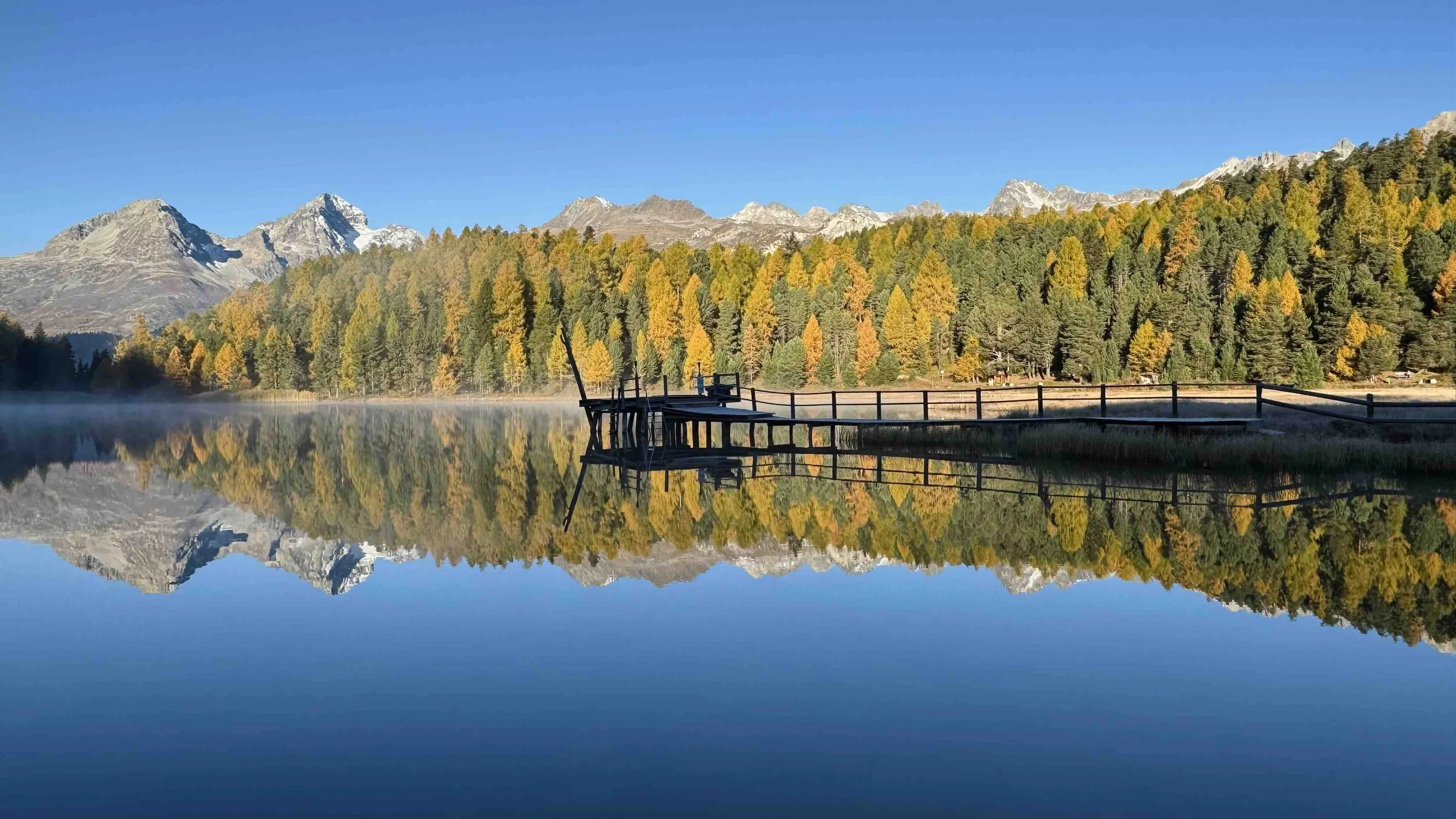
On autumn mornings, the wind often takes a pause. The lakes become almost perfectly still, reflecting the surrounding mountains with remarkable clarity, as if the landscape had found a second sky.
If you rise early, you may find a light mist floating above the water. Then, little by little, the sun appears. The mist slowly dissolves and, as the light reaches the mountain peaks, their reflections emerge once again on the lake.
These moments never last long. Perhaps that is exactly why they stay with us. If you wake up to a clear morning during your stay, it's well worth heading out a little earlier than usual for a walk beside one of the lakes.
At that hour, the Engadin seems to speak in a whisper.
Golden Forests
When the mountains change their colours.
Between late September and October, the larch trees begin their slow transformation. For a few weeks, the Engadin fills with shades ranging from pale yellow to deep gold, while the evergreen pines make the changing colours stand out even more.
Many people ask which forest is the most beautiful. The answer, in truth, is simple: almost all of them.
Every trail, every valley and every hillside experiences this transformation in its own way. Don't search for the perfect spot. Choose a forest, follow a path and let yourself be surprised by the small details: a sunbeam filtering through the trees, a falling leaf or the sound of your footsteps beneath the canopy.
If, during your walk, you hear the distant call of a red deer, stop for a moment. It is one of the sounds that announces the arrival of autumn in the mountains and makes this season even more special.
Autumn Light
When everything feels a little closer.
With the arrival of autumn, it isn't only the colours that change. The light changes too.
The days grow shorter, the sun stays lower on the horizon and bathes the mountains in a warmer, softer light. In the morning the air is wonderfully clear, while in the late afternoon the mountain slopes slowly begin to glow.
It is a season that invites you to head out early, but also not to hurry home. Sometimes all it takes is staying a few minutes longer on a bench or along a trail to watch the landscape quietly transform before your eyes.
Perhaps that is the greatest gift of autumn: reminding us that nature never changes all at once, but little by little.
And that, to notice it, all we need to do is give it a little time.
Three Ways to Notice Winter
Winter doesn't simply cover the Engadin in snow. It changes the way the landscape appears, the way we perceive space and even the way we move through it. If you're here during the winter months, take a moment to notice these three quiet transformations.
Contrasts
When opposites exist together.
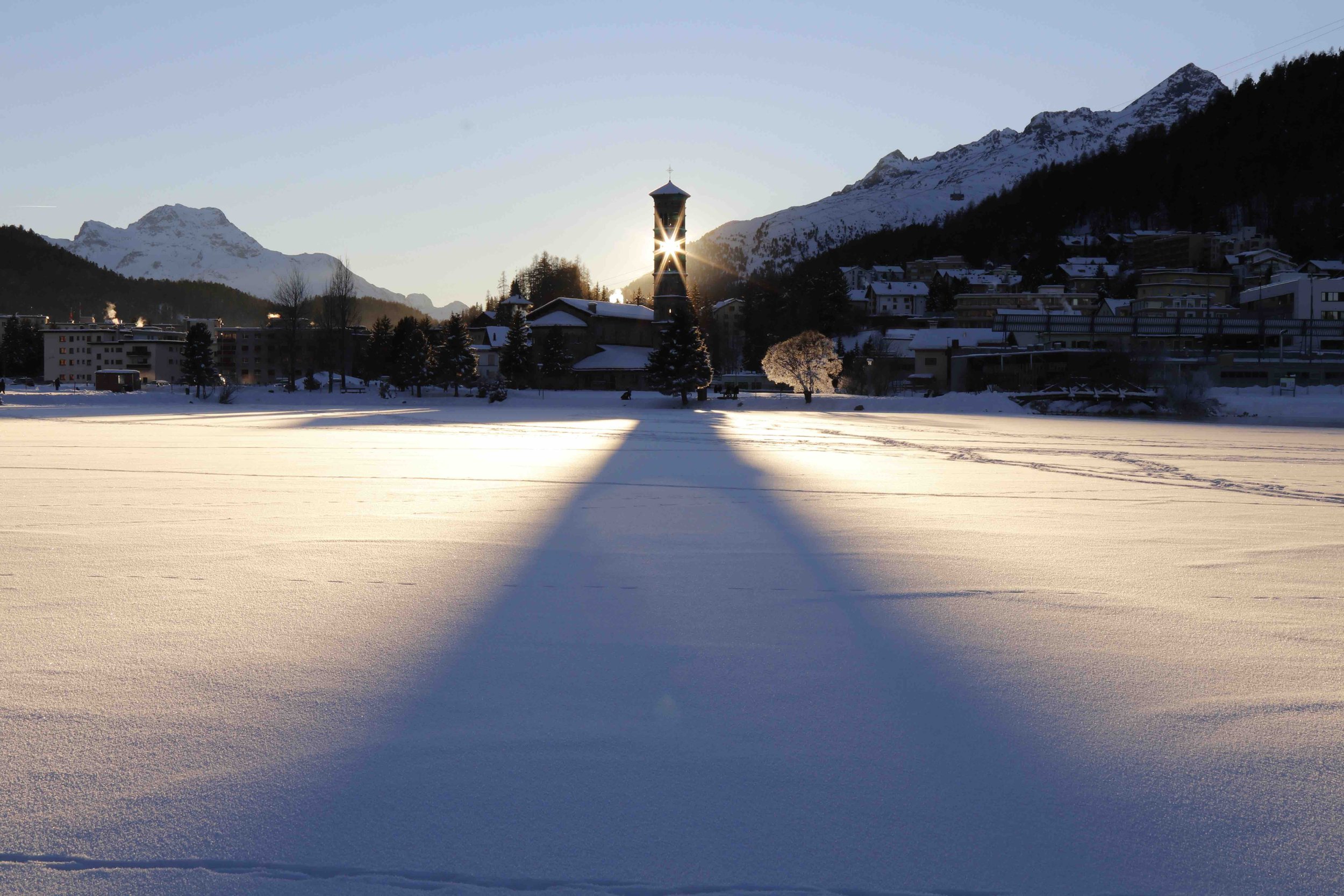
Winter in the Engadin is a season of contrasts. The sky turns a deep cobalt blue while the snow blankets everything in white. The air is crisp and cold, yet even on the coldest days, the sun warms your face with surprising strength.
Sunrises and sunsets feel even more vivid, perhaps because everything around them is so still and quiet. In the forest or along a trail, the sound of your footsteps on the snow seems to echo through the silence, as if the landscape itself were responding to every step.
Perhaps this is one of the first ways to notice winter: discovering that here, cold and warmth, colour and white, silence and sound do not oppose one another. They exist together, making the landscape feel remarkably alive.
Ice
When the landscape changes shape.
In winter, ice does more than cover the lakes. It changes the very way the landscape can be explored. When a lake freezes completely, places that separate people in summer suddenly become places you can walk across. You can stand in the middle of the lake, surrounded by mountains, seeing them from a perspective that simply doesn't exist during the rest of the year.
But ice also works in the smallest details. It wraps itself around branches, coats the dry stems rising through the snow and settles on stones beside mountain streams, turning everything into delicate crystal sculptures. Things that barely catch your eye in summer suddenly take on a new presence, as if the landscape had slowed down, inviting you to notice it more closely.
Perhaps this is one of winter's quiet gifts. Ice doesn't just change what we see. It changes the way we can inhabit the landscape.
Snow
When even space becomes visible.
When it snows, it isn't only the mountains, forests and rooftops that change. It is as if space itself begins to change.
For a few hours, the air fills with thousands of snowflakes, and what we usually experience as empty space suddenly becomes visible. The space between the sky and the earth, between one tree and another, between ourselves and the mountains reveals itself as something alive—something that connects everything rather than keeping it apart.
Then the snow settles. It covers paths, meadows, rocks, houses and lakes with the same gentle touch. White does not follow the boundaries of things. It softens them, crosses them and quietly brings them together. For a while, it no longer matters where a meadow ends and a road begins, where a roof gives way to a hillside. Everything seems to belong to the same landscape.
Perhaps this is one of winter's most silent gifts. Snow does not cover the world. For a little while, it gives it back to us as a single place.
Continue Exploring
Find places to experience each season in your own way.
Staying in St. Moritz?
If you're looking for a quiet holiday apartment in the heart of the Upper Engadin, discover Chesa Altrova.